Get to Know Your Knives
You don’t need a drawer full of blades to cook well. You need three and they better be sharp.
First, the chef’s knife. This is your workhorse. If you could only have one, make it this one. It handles chopping, slicing, dicing, and mincing. Look for one with a comfortable grip and a balanced feel in your hand.
Next, the paring knife. Think precision: peeling, trimming, deveining shrimp, coring strawberries. It’s for the small stuff, the delicate stuff, and anything the chef’s knife would bully.
Third, the serrated knife. It’s essential for cutting through tough exteriors without crushing soft interiors bread, tomatoes, citrus. Not ideal for chopping or slicing proteins, but unbeatable for anything with a crust or skin.
Avoid the knife blocks that promise twelve different blades but deliver zero consistency. One sharp, decent quality chef’s knife outperforms a shelf’s worth of dull ones. Dull knives are dangerous they slip, they fight back, and they ruin your ingredients.
Keep it simple. Keep it sharp.
Want a full rundown? Check out the kitchen basics guide.
Grip and Form Matter Most
Let’s get this straight: how you hold your knife can make or break your safety, speed, and stamina in the kitchen. Grabbing it by the far end of the handle and swinging wildly like you’re in a food fight? That’s a fast track to slicing the wrong thing. The proper grip is called the “pinch grip” you pinch the blade itself, right where it meets the handle, using your thumb and the side of your index finger. The rest of your fingers wrap around the handle. It feels weird at first, but it gives you far more control than holding the knife like a club.
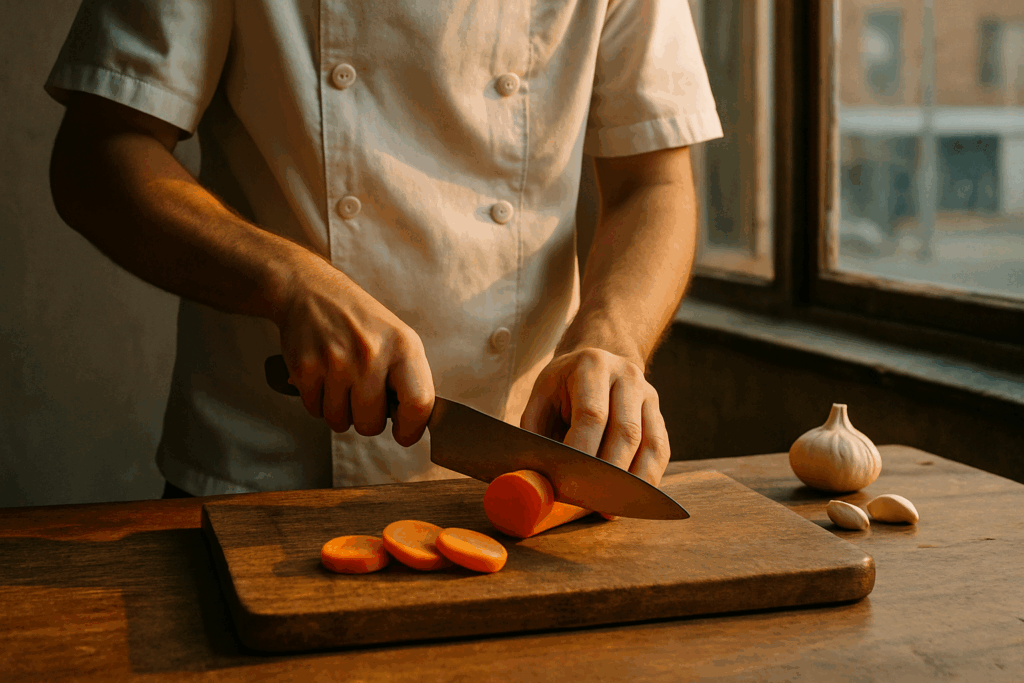
Your guiding hand the one that holds the food should curl its fingertips inward, knuckles facing forward. This creates a sort of angle guard, keeping your fingertips clear of the blade. Your knife should lightly brush the knuckles as you cut. Done right, it’s more stable and keeps your digits intact.
Now, the common pitfalls. One: holding the knife too far back on the handle (hello, wobbly cuts). Two: laying your index finger along the spine of the blade like you’re pointing it this limits fine control and puts strain on your hand. Three: loose grip, floppy wrist, no pressure. You want relaxed but firm, with the motion coming from your shoulder and elbow, not just your wrist.
Master the grip, and everything else starts falling into place.
Cuts That Actually Matter

If you can master a few basic cuts, you’re already ahead of the curve. These aren’t just about looks they change how your food cooks, how it tastes, and how much control you have in the kitchen.
Start with the dice. Small dice (about 1/4 inch cubes) cook fast and evenly ideal for soups, sautés, or anything that needs uniform heat. Medium dice are solid all rounders, and large dice work when you want bold texture, like for roasted vegetables. The key is consistency. Uneven sizing? Expect uneven results.
Julienne is next. Thin, matchstick like slices perfect for stir fries, salads, or anything you want to look sharp and cook lightning fast. Pick a firm veg carrots, bell peppers, zucchini and keep your cuts tight and uniform.
Mincing is all about going fine. Garlic, herbs, onion mince them to get maximum flavor distribution without overpowering the bite. Use a rocking motion with a sharp blade. Don’t rush; precision wins over speed here.
Chiffonade is your go to for leafy greens and herbs. Stack, roll, and slice into neat ribbons. Ideal for garnishes or folding into pastas and stews where you want color and an herbal kick without clumps.
Nail these four and your knife work stops being guesswork. Instead, it sharpens the look, the flavor, and the overall flow of your kitchen game.
Speed Comes After Control
If you’re chasing speed in the kitchen, you’re chasing the wrong goal. Rushing with a knife doesn’t just lead to sloppy cuts it leads to cuts on your fingers, too. When your hands get ahead of your head, mistakes happen. A dull chop here, a slip there, and suddenly you’re dealing with blood instead of dinner.
Speed is not the mark of a great cook. Control is. And control only comes from practice. Start slow. Focus on clean, even cuts. Train your hands to move on muscle memory, not adrenaline. Learn to keep your fingertips tucked and your eyes locked in. It’s not flashy, but it works and eventually, speed shows up on its own.
Spend ten minutes a day working on one cut. Lay out carrots or onions and aim for symmetry, not speed. Build precision like a habit. Because once accuracy becomes automatic, efficiency follows. And more importantly, you stay in one piece doing it.
Caring for Your Blade
You don’t need a dozen knives you need one that works like it’s supposed to. That only happens if you take care of it. First, let’s talk sharpening. You don’t need an electric contraption or a special subscription service. A whetstone and a honing steel will do the job. Honing should happen often every few uses. It straightens the edge and keeps it slicing. Sharpening, on the other hand, removes metal and should only be done when the blade starts dragging (think every few months, depending on how much you cook).
Next, cutting surfaces. Wood and plastic boards are your friends. Bamboo works, too. What you want to avoid: glass, marble, or anything hard enough to dull your knife the moment it hits the board. If it clinks when the blade drops, it’s doing damage.
Storage matters more than you think. Tossing your knife in a drawer is a surefire way to ding the edge or worse cut yourself fishing it out. Use a magnetic strip, a knife block, or a blade guard. Keep it clean, dry, and protected, and it’ll serve you for years.
Like most good tools, your knife asks for respect. Give it that, and it’ll reward you every time you step into the kitchen.
Build Skills from the Ground Up
Getting better with a knife isn’t about flashy moves it’s about nailing the basics and repeating them until they’re second nature. Start slow, stay consistent, and aim for clean cuts over quick ones. Once you’ve got control, everything from meal prep to presentation gets easier and sharper.
Confidence in the kitchen starts with competence. The more muscle memory you build through proper technique, the more fluid your cooking becomes. No hacks, no shortcuts just solid skills that stick.
For a deeper look at everything from cutting boards to stovetop know how, check out our full kitchen basics guide.

 Carol Manginorez is the kind of writer who genuinely cannot publish something without checking it twice. Maybe three times. They came to meal prep ideas through years of hands-on work rather than theory, which means the things they writes about — Meal Prep Ideas, Food Trends and Culture, Healthy Eating Tips, among other areas — are things they has actually tested, questioned, and revised opinions on more than once.
That shows in the work. Carol's pieces tend to go a level deeper than most. Not in a way that becomes unreadable, but in a way that makes you realize you'd been missing something important. They has a habit of finding the detail that everybody else glosses over and making it the center of the story — which sounds simple, but takes a rare combination of curiosity and patience to pull off consistently. The writing never feels rushed. It feels like someone who sat with the subject long enough to actually understand it.
Outside of specific topics, what Carol cares about most is whether the reader walks away with something useful. Not impressed. Not entertained. Useful. That's a harder bar to clear than it sounds, and they clears it more often than not — which is why readers tend to remember Carol's articles long after they've forgotten the headline.
Carol Manginorez is the kind of writer who genuinely cannot publish something without checking it twice. Maybe three times. They came to meal prep ideas through years of hands-on work rather than theory, which means the things they writes about — Meal Prep Ideas, Food Trends and Culture, Healthy Eating Tips, among other areas — are things they has actually tested, questioned, and revised opinions on more than once.
That shows in the work. Carol's pieces tend to go a level deeper than most. Not in a way that becomes unreadable, but in a way that makes you realize you'd been missing something important. They has a habit of finding the detail that everybody else glosses over and making it the center of the story — which sounds simple, but takes a rare combination of curiosity and patience to pull off consistently. The writing never feels rushed. It feels like someone who sat with the subject long enough to actually understand it.
Outside of specific topics, what Carol cares about most is whether the reader walks away with something useful. Not impressed. Not entertained. Useful. That's a harder bar to clear than it sounds, and they clears it more often than not — which is why readers tend to remember Carol's articles long after they've forgotten the headline.